Thursday, 27 February 2014

Fin!

Finally it's time to bring this blog to an end. We went through the ups and downs of communication and how it can effect you. The differences in gender communication and listening styles, and let's not forget the generation gap! 

Now that we are aware of what stereotypes can really do to someone, we can all learn to STOP IT!

So do your research, be aware and learn to accept the differences we have amongst the genders. Because, let's be honest for a second...

Who wants to be the same as everyone else?

NOT ME!

So with that said, I'll leave you guys with this short video I found to be really interesting. ENJOY!


The Generation Gap

We've taken a look at the differences between the way male and females communicate and listen, now let's take a look at the bigger picture. Not between just genders, but generations inclusive.

As we grow and move towards our future, so does the generation gap. The gap persistently increases over time. The old days are not what they used to be. Everything has changed and will keep changing to meet the needs of the society we live in. The gap between youth and the elderly is so big now, that the communication between the two is so apparent. 
http://historeo.com/Resources/generationgap.gif

The "Matures"

Those born between 1909-1945. Communication is still caught in the past. Using old fashion methods and tools like email and mobile applications to communicate is too impersonal to keep their trust – they need personal, one-on-one dialogue to feel engaged and connected. The casual stop-and-chat may turn into a bit longer conversation with this group, but the extra face-to-face time is essential to keep them updated and involved in company strategies. (HNi, 2012)

The Baby Boomer Generation 

Born between 1946-1964. Many Baby Boomers have started adopting technology uses in their life, but are still learning. This generation may engage with digital media, but they generally prefer communications in person. (HNi, 2012)

Generation X


When it comes to communicating with Gen X-ers, they are generally comfortable with web-based communications [especially email] and enjoy having options available to them.  Conference calls, video, and web collaboration tools may be more effective at keeping this group productive and engaged than meetings.
Many Gen X-ers have jumped right into social media. Others, not so much.  Although it may take some urging, there is an opportunity to encourage this generation to extend their channels of correspondence to blogs, LinkedIn accounts, and Twitter feeds and leverage them to build your digital brand. (HNi, 2012)

Generation Y (Millennial)

When communicating with this group, remember that they invented the social network and are used to consuming information in short, concise chunks. Texting, email, and all forms of social media are the communication channels this group is most at home with. (HNi, 2012)

Sources: 
  • HNi. (2012). The Great Divide: Communicating Across The Generation Gap. Retrieved from: http://hni.com/blog/bid/77671/The-Great-Divide-Communicating-Across-The-Generation-Gap


Differences in Gender Listening Styles

Men and women vary in many ways, it's interesting to see and observe the little things that we do while in a conversation. When both genders interact, their listening skills are apparent during a conversation. Body language and tone of voice also play a role, but in this post, we will focus just on the listening styles of both genders. 


At meetings women nod their head to show they are listening. Men think the woman is agreeing with them. He then assumes the women will go along with his idea. He is surprised when she later disagrees, since she nodded her head. She has no idea why he thought she agreed with him since he never asked her. (Lieberman, n.d.)

At meetings, men only nod their heads when they agree. If a women is speaking and she doesn't see his head nod as he listens, she assumes he either disagrees or is not listening.
(Lieberman, n.d.)

Men are more likely to be action-oriented listeners, which means they focus on listening to information pertinent to the task at hand. Action-oriented listeners have little patience for speakers who ramble off topic or include unnecessary details. Women are more likely to be people-oriented listeners. They connect with the emotional message and undertones of a conversation and are more concerned with the occurrence of the conversation than with the pertinent information discussed. (Black, 2011) 

Men and women in listening roles during conversations tend to express their responsiveness in different ways. Women often interject with small acknowledging remarks such as “yes,” “I see,” and “mm-hmm” to show the speaker that they are actively listening and processing the contents of the conversation. Men tend to listen silently, interjecting sparsely and usually only to ask clarification. The difference in response style can cause women to assume that men aren't actively listening to them in conversations, while men tend to think that women over-listen. (Black, 2011) 

Something I found to be of interest to you guys is this data that you can find at: Queendom.com

3% admitted that they don’t make eye contact.
12% will finish someone’s sentences.
16% will correct the speaker if they mispronounce a word.
17% have a tendency to interrupt.
19% will purposely divert or end conversations that don’t interest them.
20% admit that they perform other tasks at the same time (e.g. watch TV, cook).
23% fidget (play with hair, look at watch, tap feet, drum fingers).
27% make disapproving faces if they don’t agree with the speaker.
31% are thinking about how they will respond to the speaker.
40% admit that their mind wanders if they find the topic of conversation boring.
Sources:
  • Lieberman, Simma. (n.d.). Simma Lieberman Association. Differences in male and female communication styles. Retrieved from: http://www.simmalieberman.com/articles/maleandfemale.html
  • Black, Ashley. (2011). eHow Contributor. Differences in listening between men and women. Retrieved from: http://www.listeningimpact.com/tag/gender-differences/
  • Thier, Marian. (2011). Queendom. Do women talk more than men?. Retrieved from: Queendom.com

Differences in Male and Female Communication

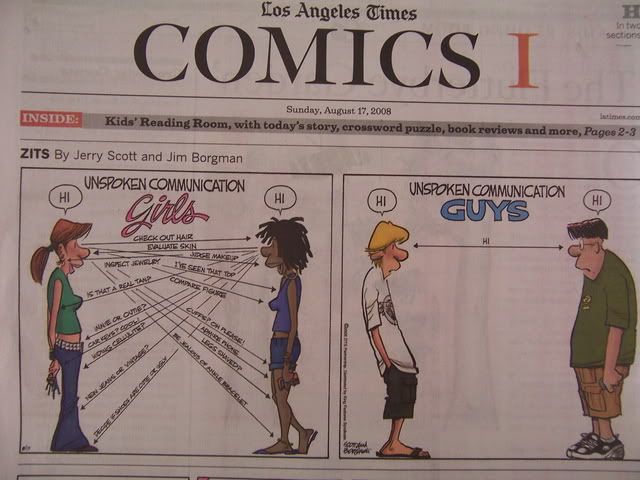
As I said in my earlier posts, we all have our differences and the way we communicate is no exception. We all live on the same planet yet we criticize each other as if we are worlds a part. We have been brought up in a society that teaches us to think and behave, it molds our personality and ways of life are learnt. 

Communication is perceived through different forms and we are all taught communication methods differently based on our circumstances and the situations each individual faces.   

"Too often men and women see the differences between each other and make each other wrong, rather than appreciating how they can benefit from those differences."        
(Lieberman, n.d.)


Examples of Typical Differences in Male and Female Communication Styles

  • Women are more likely to talk to other women when they have a problem or need to make a decision. Men keep their problems to themselves and don’t see the point in sharing personal issues.
  • Women are more relationship oriented, and look for commonalities and ways to connect with other women. Men tend to relate to other men on a one-up, one-down basis. Status and dominance is important.
  • Women focus on building rapport, by sharing experiences and asking questions. Men like to tell and give information rather than ask questions. They share experiences as a way of being one-up.
  • If women have a disagreement with each other it affects all aspects of their relationship. Men can have a disagreement, move on to another subject and go get a drink together.
  • Women get things done at work by building relationships. Men build relationships while they are working on tasks with each other.
(Lieberman, n.d.)

Sources:

  • Image: http://i271.photobucket.com/albums/jj147/roundroundworld/UnSpokenCommunicationBetweenGirlsan.jpg
  • Lieberman, Simma. (n.d.). Simma Lieberman Associates. Differences in male and female communication styles. Retrieved from: http://www.simmalieberman.com/articles/maleandfemale.html

How Can You Overcome Stereotypes in the Workplace?

Now we looked at both male and female gender stereotypes that occur, and some consequences that arise from them. It's an ugly truth that we all have to face or will face sometime in our lives.

Workplace stereotype is common, and whether your directly involved or not, their are ways to decrease it for when it does happen. Stereotyping can have a negative effect in the workplace and makes everyone feel uncomfortable and lowers an individuals self- esteem. So instead of getting mad over it, let's grab it by the horns and chuck it away for good! Let everyone know whose in control!   

So how can you avoid these stereotypes in your workplace? 

1. Encourage Team work
• Team work builds relationships among employees
• Employees are more open to learn about different cultures
• Make people feel comfortable about sharing
2. Expand employee knowledge about diversity
• Teach employees about cultural difference
• Apply effort to you endeavor to learn from things you
don’t understand
3. Have an open mind
• Look at situations from other person’s point of view
• Be open to new experiences
• Practice humility
(worldpress.com, 2011)
Sources:
  • The Twenty Ten Theme. (2011). Ethical Values: Stereotyping in a workplace. Retrieved from: http://achaudhry79.wordpress.com/2011/04/26/stereotyping-in-a-workplace/


Female Gender Stereotypes

Since we talked about male gender stereotypes in my previous blog post, it's only right  to be talking about what women gender stereotypes are as well. Just like men, women have to face this ugly truth, the only difference is that male gender stereotypes are more hidden and less apparent than women gender stereotypes are. 

So, let's take a look at some typical women gender stereotypes:
(Brewer, 2014)
  • Women are supposed to have "clean jobs" such as secretaries, teachers, and librarians
  • Women are nurses, not doctors
  • Women are not as strong as men
  • Women are supposed to make less money than men
  • The best women are stay at home moms
  • Women don’t need to go to college
  • Women don’t play sports
  • Women are not politicians
  • Women are quieter than men and not meant to speak out
  • Women are supposed to be submissive and do as they are told
  • Women are supposed to cook and do housework
  • Women are responsible for raising children
  • Women do not have technical skills and are not good at "hands on" projects such as car repairs
 Something interesting I found in an article online talks about the scarcity of women in the upper levels of organization due to women gender stereotypes demeaning them and their work ethics. 

"It is proposed that gender stereotypes and the expectations they produce about both what women are like (descriptive) and how they should behave (prescriptive) can result in devaluation of their performance, denial of credit to them for their successes, or their penalization for being competent. The processes giving rise to these outcomes are explored, and the procedures that are likely to encourage them are identified. Because of gender bias and the way in which it influences evaluations in work settings, it is argued that being competent does not ensure that a woman will advance to the same organizational level as an equivalently performing man." (Heilman, 2001)

You can read the rest of the article for more insight on what goes on in the business world and how it can effect you with the link below: 

http://onlinelibrary.wiley.com/doi/10.1111/0022-4537.00234/abstract

Sources:

  • Brewer, Holly. (2014). Health Guidance: List of gender stereotypes. Retrieved from: http://www.healthguidance.org/entry/15910/1/List-of-Gender-Stereotypes.html
  • Heilman, M. E. (2001), Description and Prescription: How Gender Stereotypes Prevent Women's Ascent Up the Organizational Ladder. Journal of Social Issues, 57: 657–674. doi: 10.1111/0022-4537.00234

Wednesday, 26 February 2014

Male Gender Stereotypes

Male gender stereotypes occur just as often as female stereotypes do. Now, you're probably thinking that I'm lying, but in all honesty it does occur, it just goes unnoticed.      


Some common stereotypes are: (Brewer, 2014)
  • All men enjoy working on cars
  • Men are not nurses, they are doctors
  • Men do "dirty jobs" such as construction and mechanics; they are not secretaries, teachers, or cosmetologists
  • Men do not do housework and they are not responsible for taking care of children
  • Men play video games
  • Men play sports
  • Men enjoy outdoor activities such as camping, fishing, and hiking
  • Men are in charge; they are always at the top
  • As husbands, men tell their wives what to do
  • Men are lazy and/or messy
  • Men are good at math
  • It is always men who work in science, engineering, and other technical fields
  • Men do not cook, sew, or do crafts
Such stereotypes can hurt an individual from personal and professional growth. (Cliffs notes, 2013)
Sources:

  • Brewer, Holly. (2014). List of Gender Stereotypes: Male gender stereotypes. Retrieved from: http://www.healthguidance.org/entry/15910/1/List-of-Gender-Stereotypes.html
  • Image: http://s2.quickmeme.com/img/96/9655006edee530d601e68a0c15a045f58bdb791ec52850347f9a91543c26a496.jpg
  • Houghton Miffilin Harcourt. (2013). Cliffs Notes: Gender stereotypes. Retrieved from: http://www.cliffsnotes.com/sciences/sociology/sex-and-gender/gender-stereotypes

What is Gender Tension?

Gender tension relates to all the different stereotypes that we hear or see happening in the workforce nowadays. 

While it's hard to overcome the barriers that society has put on both genders, we can help minimize the scrutiny of stereotypes.

 Stereotype:"A generalization, usually exaggerated or oversimplified and often offensive, that is used to describe or distinguish a group." (dictionary.com)

Gender tension happens all around us and there are ways to avoid being put in awkward situations. Try to avoid any stereotypes that may occur, be professional and understanding of each other to create a friendly, workable environment. 

Gender stereotyping in the workplace is common and can have negative effects such as: (Dodds, 2006)

  1. Wage discrimination 
  2. Discrimination in employer hiring, firing and promotional practices
  3. Sexual harassment and pregnancy discrimination   


Sources:


  • Image: https://blogger.googleusercontent.com/img/b/R29vZ2xl/AVvXsEjOtROUGeFg5GRT5TtfCR2Yg8KmIcDoJbU5wAkPP2BKCcFVJTqSwstJTo4MGuKD1vcMriBbwIB361FV3o0Aa515WljY83YwgdCxh3y8S1ND1Z-2CQ2fBi6Ko0X-Dd5QWXG1jeJ_T72TJZ7D/s900/yahah.jpg
  • Definition: stereotypes. (n.d.). The American Heritage® New Dictionary of Cultural Literacy, Third Edition. Retrieved February 26, 2014, from Dictionary.com website:http://dictionary.reference.com/browse/stereotypes
  • Dodds, Danica. (2006). Today's Workplace: Gender stereotyping in the workplace and the discrimination it creates. Retrieved from: http://www.todaysworkplace.org/2006/12/01/gender-stereotyping-in-the-workplace-and-the-discrimination-it-creates-danica-dodds/

What is Gender Talk?

Gender talk is the way men and women communicate with one another. It is very easy to get carried away with this since power and authority play a huge role in the workforce. 

There are far more women working in the business sector than there were 10-15 years ago. In fact, 50% or more of privately owned companies are owned by women. (Krotz,2011) Now, that is something to feel proud of! 

So, why do we have these differences? Well, simply because men and women have different ways of communicating. If you are wondering whose right and whose wrong, well STOP right there! We all have our differences and that is what makes the workforce so diverse. With everyone thinking and acting alike, where would we get all our new ideas and innovations from?

Here is a video to help you better understand gender talk. Hope you all 
will enjoy this!!!


Sources:

  • Krotz, Joanna L. (2011). 6 Tips for bridging the communication gap. Retrieved from: http://www.microsoft.com/business/en-us/resources/management/leadership-training/women-vs-men-6-tips-for-bridging-the-communication-gap.aspx?fbid=S6kQPIzt5uj
  • Video: http://www.youtube.com/watch?v=xk0e9Ns_ml8

Thursday, 30 January 2014

The Battle of the Genders!

Hey guys, this is my first blog ever so be patient and just work with me on this one. So if you’re reading this, you probably are aware of what this blog will be about. I can’t stress how annoying it is to be working with the opposite gender and not getting any work done or either we end up fighting because we can’t see eye to eye. Sometimes I feel like men don’t even listen to what women have to say and use their ideas instead of ours, and all the ladies out there I am sure you can agree. 

But have you ever wondered why we have our differences? It’s all about communication and this is where the difference in how genders communicate creates misunderstanding. Now, before I start going into detail about what everyone is anxiously waiting to read, let me start off by letting my readers know what is to come in my future blog posts. 

Not everyone is familiar with what gender talk and gender tension is, so I’ll clear up that for you guys. Let’s take a closer look at the differences in male and female communication, the listening skills they both have and how they differ and while we are at it, we can compare gender talk and gender tension in youth and old age. Seeing and knowing the differences in genders and how they communicate will help all of us in the long run, not just your employers and trust me on that one. 

So now I want you to help me out, yes you! Share some of your stories and experiences that you had with this. I can’t wait to read what you guys have to say!